Quick answer
Not the whole test, and only under an optometrist's control. The law says only a registered optometrist or doctor may test sight. Trained support staff already carry out checks such as eye pressure, visual fields and retinal imaging in most practices, and the General Optical Council wants to confirm that an optometrist may delegate parts of the sight test while staying in overall control. It has also proposed allowing the test to be split by time, person or place, including teleoptometry, with safeguards. The consultation closed on 21 October 2026 and no decision date has been set. The AOP opposes the proposals as drafted. Practices planning a pre-screening room or new imaging can plan the investment now, but should not rely on rules that are not yet final.
What has the GOC proposed for the sight test?
The General Optical Council, which regulates optometrists and dispensing opticians in the UK, has consulted on a new statement on the testing of sight to replace its 2013 position statement. The consultation opened on 15 July 2026 and ran for 14 weeks, closing on 21 October 2026. It has two parts.
- Delegation. An optometrist could delegate some parts of the sight test to a suitably trained person, as long as they stay in overall control and oversee the work.
- Separation. Parts of the test could be split by time, person or place, for example through teleoptometry, with safeguards on clinical audit, staff training, a risk based check of whether each patient is suitable, patient choice and consent, and patients in vulnerable circumstances.
The GOC also wants to confirm that every sight test must include both an eye health check and a vision check, and that a spectacle prescription cannot be issued until all the statutory parts are done. Steve Brooker, its Director of Regulatory Strategy, said delegation means "freeing up optometrists to focus on clinical decision-making and patient care". If you run an independent practice, our page on optician practice loans covers the funding side of any change to how your clinics work.
Who is allowed to test sight now?
Under section 24 of the Opticians Act 1989, only a registered optometrist or a registered medical practitioner may test another person's sight, with narrow exceptions for students and trainees. That does not change. What the GOC is updating is its guidance on how much of the process others can carry out, and where and when.
In practice, a lot is already delegated. When its Council approved the consultation in June, the GOC said routine tests such as eye pressure, visual fields, autorefraction and retinal imaging are now often done by trained support staff. The proposals would put that on a clearer footing and go further, so a practice could design clinics around pre-screening by optical assistants and remote review by an optometrist. Busy practices, such as those in London, could gain most from freeing up optometrist time.
Why does the AOP oppose the proposals?
The Association of Optometrists (AOP) published its response on 23 October 2026 and opposes the proposals in their current form. It says routine separation of the sight test is not permitted under the Opticians Act, although limited, clinically justified separation is. It agrees subjective refraction should not be delegated, wants delegation defined clearly, and argues for compulsory registration of optical businesses with real sanctions before any of this goes ahead.
Its survey drew 661 responses. Of 578 people who answered the question, 52% said separating the sight test could have benefits, 35% said it could not and 14% were not sure. Around 69% of employed optometrists and 72% of locums who answered said they work where other team members carry out tests, and nearly 4% of employees and nearly 10% of locums said the optometrist has no control over which tests are done. AOP chief executive Adam Sampson said the proposals raise "fundamental concerns" about safety and accountability. Its strongest objection is to teleoptometry, and respondents also opposed pre-screening done days or weeks before the examination.
Will optometrists have to be on the premises?
That is the main open question. The GOC set out two options for its supervision and delegation standard. Under Option 1, a delegating optometrist could oversee remotely as long as another registrant is on site. Under Option 2, no registrant would need to be on the premises, but the delegating optometrist must still be able to oversee the work and step in. For optical students, the GOC proposes keeping the rule that a registrant is on the premises.
The AOP supports Option 1 and opposes Option 2, and says the on site optometrist must have a clinic diary that leaves real time to intervene. Which option the GOC picks will shape staffing. Option 1 suits a practice with at least one optometrist in every clinic. Option 2 would open the door to more remote models, which is why the AOP worries about commercial pressure on clinicians. If you are planning to recruit optical assistants or another optometrist, it is worth waiting to see which way it goes before you commit to a staffing model.
When will the GOC decide?
The GOC has not given a date for a decision or for any new statement to take effect. It will now consider the responses before publishing a final version. Until then the 2013 statement and the current standards apply, so nothing changes in your clinic tomorrow.
That gives owners time to plan rather than react. Look at which checks your team already does before the eye examination, whether your rooms and booking system could support more of it, and what you would need to buy. Our report on enhanced eye care services covers the other big source of clinical work for independents this year, and much of the same equipment serves both.
What equipment and space does delegated testing need?
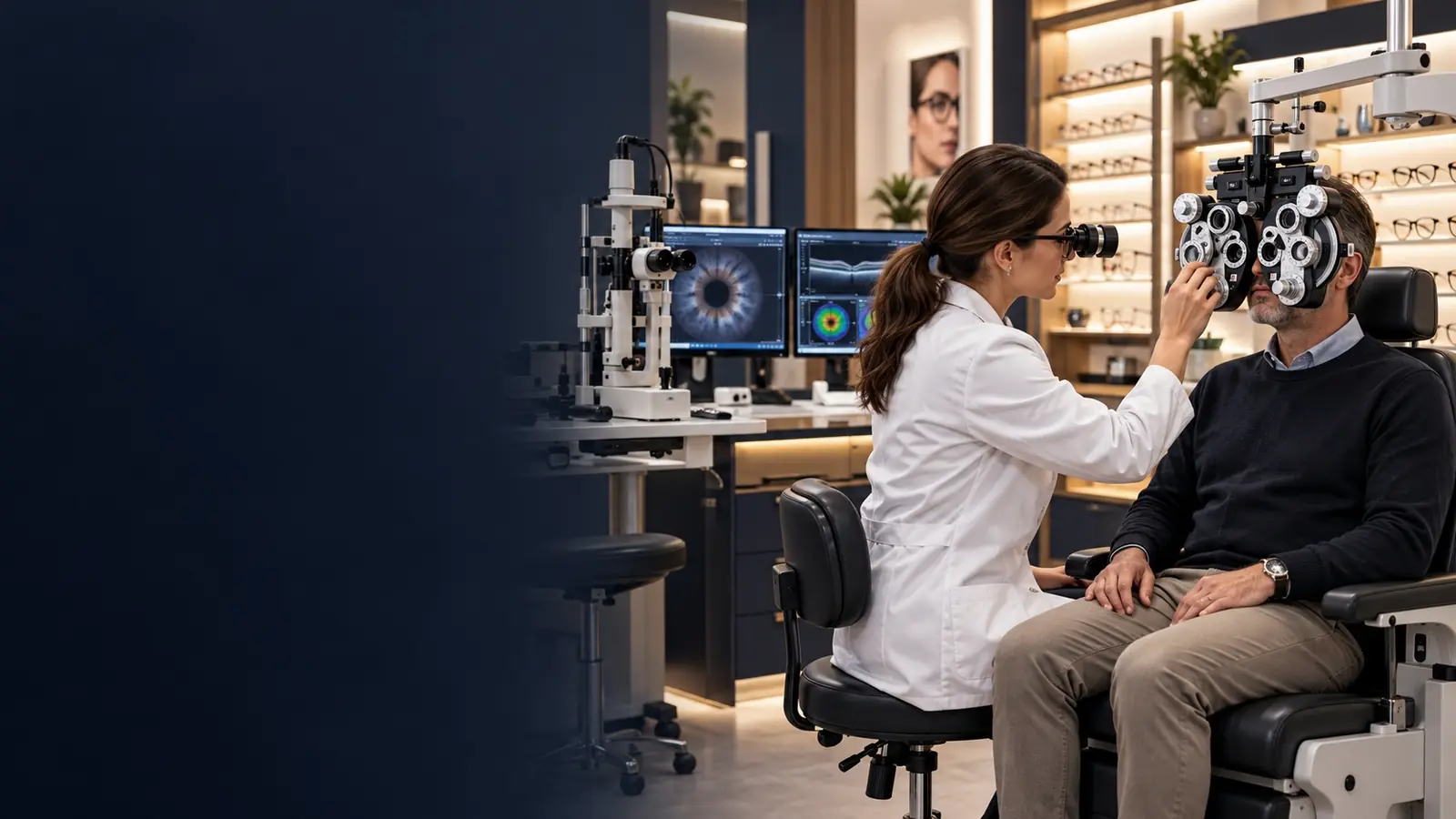
Delegated pre-screening only works with the right kit in the right place. A typical pre-test room or area has an autorefractor, a non contact tonometer, a visual field analyser and a fundus camera or OCT, so a trained assistant can take a patient through the checks before they see the optometrist. Remote review adds secure image sharing and a practice management system that links the results to the record.
That points to three kinds of spend. Practice equipment finance covers the diagnostic kit, refurbishment finance covers converting a room or reworking the shop floor, and IT and software finance covers the systems. Our guide to hire purchase and leasing explains which suits each item. If your existing OCT or field analyser is paid for, equipment refinance can release cash against it to part fund the upgrade.
How do optical practices fund a pre-screening room?
Lenders that know optometry usually fund diagnostic equipment on hire purchase or a lease over a fixed term, secured on the equipment itself, so the repayments come from the extra appointments it creates. A fit-out is often funded alongside it or with an unsecured practice loan. Lenders will want to see your accounts, your NHS and private income split, and a sense of how the investment adds capacity. Our guide to preparing a practice finance application lists what to gather.
Bigger plans need bigger thinking. A second pre-test room or a new branch is practice expansion finance, and opening from scratch is covered in our starting a practice hub. If you are weighing up buying another practice to spread optometrist time across sites, our guide to buying a professional practice and the practice purchase loan calculator are a good place to start. The growing a practice hub brings these together.
What about training, liability and indemnity?
The AOP's sharpest warning is about liability. It says optometrists could stay professionally responsible for checks they cannot fully control. Whatever the GOC decides, a practice that delegates more should have written protocols, recorded training for every assistant and regular clinical audit, which are the safeguards the GOC itself proposes. Training time costs money, and working capital facilities help cover the weeks when a new assistant is learning rather than earning.
Talk to your indemnity insurer before you change how clinics run, and check the cover for any locums who will supervise delegated work. If the premium rises, PII premium finance spreads it over the year, and our PII premium finance guide and PII premium finance calculator show how it works. Owners nearing retirement may also find the changes affect what a buyer will pay, which our pages on succession finance and goodwill finance cover.
What it means for your funding
Nothing changes until the GOC publishes a final statement, and it may not look like the draft. The direction is clear, though. More of the sight test is already done by trained support staff, and the regulator wants to support new ways of working. Independents that plan their equipment, rooms and staffing now will be ready whichever option is chosen. It also fits the wider pressures on practices this year, from the Budget changes to wages and tax to where interest rates go next, and the growth in private eye care that our report on record self-pay touches on.
We are a broker, not a lender. We compare whole of market options for optical equipment, fit-outs, IT and working capital, and approach the lenders that suit your practice. Fees depend on the lender. Instant Quotes shows which lenders on our panel fit an equipment purchase, with no credit check. See how it works, what we finance, the other professions we work with, or read more practice finance news.
Common questions
Can an optical assistant do an eye test in the UK?
Not the whole test. Only a registered optometrist or doctor may test sight. Trained assistants can carry out delegated checks such as eye pressure, visual fields and retinal imaging, with the optometrist in overall control.
What parts of a sight test can be delegated?
The GOC says routine checks such as eye pressure, visual fields, autorefraction and retinal imaging are often done by trained support staff. The AOP agrees subjective refraction should not be delegated. The GOC's final statement will set the detail.
What is teleoptometry?
It is where part of the eye examination is done remotely, with the optometrist reviewing results or speaking to the patient from another place. The GOC proposals would allow it with safeguards, and the AOP strongly opposes it.
Does an optometrist have to be on the premises when tasks are delegated?
Under the current standards, yes. The GOC consulted on two options, one allowing remote oversight if another registrant is on site and one with no registrant on site. No decision has been made.
When will the GOC decide on the new sight testing statement?
The consultation closed on 21 October 2026. The GOC has not given a date for a decision or for any change to take effect, so the 2013 statement still applies.
Can an optician practice finance an OCT scanner?
Yes. OCT scanners, visual field analysers and fundus cameras are usually funded with hire purchase or leasing over a fixed term, secured on the equipment. A pre-test room fit-out can be funded alongside it.
Does checking my funding options affect my credit file?
Instant Quotes shows which lenders on our panel could fit your practice with no credit check. A lender only runs a credit search if you choose to apply, and fees depend on the lender.
Official sources
- General Optical Council, General Optical Council consults on testing of sight and delegation (15 July 2026)
- General Optical Council, Consulting on the testing of sight (25 June 2026)
- AOP, response to the GOC consultation on the testing of sight statement (23 October 2026)
- Optometry Today, GOC testing of sight proposals raise fundamental concerns, AOP says (29 October 2026)
- legislation.gov.uk, Opticians Act 1989, section 24
Published 4 November 2026. Figures and dates are taken from the sources named and were correct on that date. This article is for general information only and should not be treated as legal, tax, accounting or financial advice. Funding availability and lender requirements depend on individual circumstances.
The weekly newsletter
Articles like this, by email.
Our new articles for solicitors, accountants, dentists, vets and other practices, and what each one means for your finance.
- New articles every Friday
- What the news means for your practice
- Unsubscribe in one click